

Cheaper TMT bars cost more over the life of a building — the savings on the invoice get erased by rusted rebar, cracked concrete, and structural repairs within a few years.
When planning a construction project, it might seem like a good idea to choose low-quality steel and other low-cost Thermo-Mechanically Treated (TMT) Bars to save money. This is not beneficial in the long run. These low-cost TMT Bars can cause numerous problems, including frequent repairs, safety issues, and significant stress. Ensuring long-term structural integrity requires shifting the focus from initial cost to technical superiority — exactly where premium-quality TMT bars set the industry benchmark.
Side Effects of Low-Cost TMT Bars
Low-cost steel Bars are often not made well. They can have problems like rib profiling, which makes it hard for steel and concrete to bond together.
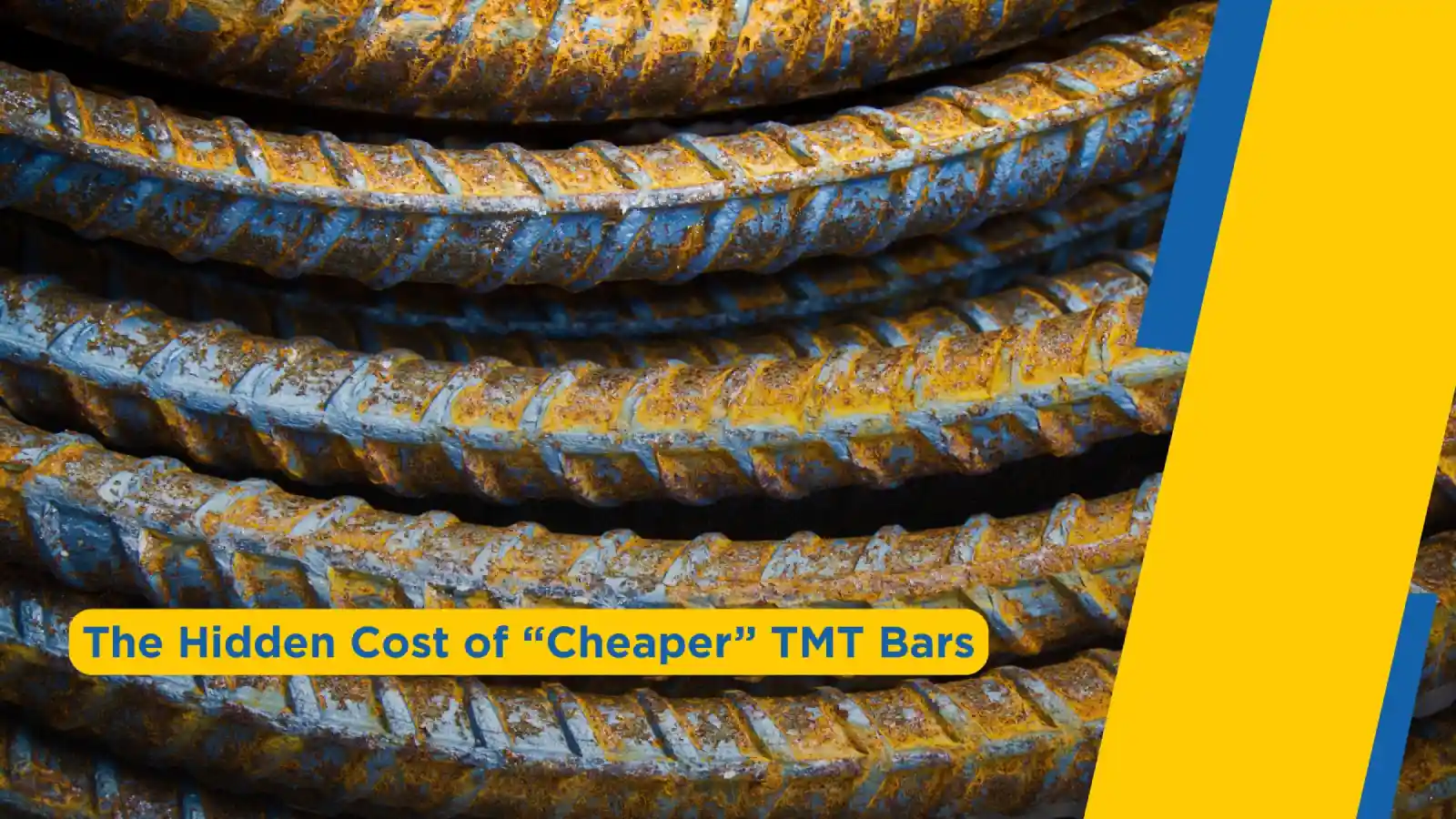
Also, when these TMT Bars are made, they can be exposed to air, which causes them to rust quickly. As the steel rusts, the concrete cracks. Low-grade scrap metal used in non-branded mills contains high levels of trapped gases and impurities that induce several internal corrosion processes. As internal steel rusts, it expands up to six times its original volume. Fixing these damages demands continuous, expensive retrofitting. This is exactly the gap that quality TMT bars are engineered to close.
In contrast, Ultramax TMT Bars-Fe 550D are engineered using Thermex technology from Hennigsdorfer Stahl Engineering GmbH, Germany. This technology creates a protective layer on the steel, which helps it stick to the concrete and prevents rust. Ultramax TMT Bars ensures an exceptionally tight concrete-steel bond and superior corrosion resistance, eliminating premature maintenance costs.
Compromising Structural Safety
The safety of a building depends on the strength and flexibility of its steel core. Low-cost Bars can be very brittle. Break easily under stress. During seismic movements and external thermal stress, brittle steel snaps abruptly under sudden load transfers. For safe, earthquake-resistant construction, the Bureau of Indian Standards (BIS) mandates strict limits on the ratio of tensile strength to yield strength. Ultramax TMT Bars Fe 500D, are precisely manufactured to optimize this balance. They feature a unique dual-phase metallurgical structure: a tough, outer tempered martensite casing for high load-bearing yield strength, surrounding a highly ductile inner ferrite-pearlite core. With a guaranteed minimum elongation of 20% and undergoing stringent 3D bend testing, Ultramax TMT Bars absorb and dissipate high kinetic energy during seismic shifts without structural failure, guaranteeing uncompromised safety.
Rapid Degradation Under Thermal Duress
Another critical technical flaw of cheaper TMT Bar is their rapid degradation under thermal duress, which can quickly transform an accidental fire into a progressive structural collapse.
- Immediate Loss of Yield Strength: Inferior steel loses its structural yield strength at lower temperatures, threatening immediate building collapse during accidental fire outbreaks.
- Microstructural Destabilization: Under extreme heat, the uncalibrated core structure of cheap steel warps, causing permanent sag and irreversible structural damage to beams and pillars.
- Crucial Loss of Evacuation Time: If steel loses its strength in minutes, occupants lose their only window to escape safely.
The Ultramax Technical Advantage
Technically optimized steel must maintain its load-bearing capacity even when exposed to extreme heat. Ultramax TMT Bars demonstrate remarkable cross-sectional thermal stability. Due to the precision-controlled German quenching and tempering process, these Bars retain their core structural strength at elevated temperatures up to 500°C. This thermal resilience provides vital evacuation time for occupants and preserves the structural frame of the building, preventing total asset loss during a fire emergency.
TMT Bars vs Traditional Steel: Why Better TMT Bars Outperform
Conventional mild-steel bars and cold-twisted deformed (CTD) bars rely on cold-working alone, which leaves the entire cross-section uniformly hard and brittle, with no ductile core to absorb stress. This is precisely why TMT bars outperform traditional steel in every load-bearing application: the thermo-mechanical treatment produces a tempered outer layer and a soft, ductile core in the same bar, giving it both strength and flexibility that plain mild steel cannot replicate. Better TMT bars take this further — a controlled quenching process, tight tolerance on rib geometry, and consistent core metallurgy across every batch, rather than the variability common in unbranded mills.
Choosing the Right TMT Bars from a Reputable Manufacturer
Picking the right TMT bars for a project isn’t only about comparing price per tonne — it means verifying what’s actually inside the bar. Ask for the mill test certificate, confirm BIS certification on every batch, and check that the rib pattern and weight per metre match the declared grade. TMT bars from reputable brands are manufactured under mill-scale quality control, not blended from scrap of unknown origin — that’s the single biggest predictor of how a bar performs ten years after the concrete is poured, not its price on the day of purchase.
Conclusion
Choosing grade structural steels can cause a lot of problems and stress in the long run. We have to keep in mind that choosing cheaper TMT Bars can cost your mental peace. Do not let the hidden costs of cheaper alternatives compromise your equity and your family’s safety. By choosing the best TMT bars from a trusted manufacturer, you are investing in your peace of mind. Ultramax manufactures high-quality TMT bars using advanced German technology — premium TMT bars built for structures that need to last decades, not just pass the first inspection. You will be protecting your investments, your building, and your family’s safety.