

Deep inside walls, strength begins with what most never see. Though designs today chase sleek looks, real staying power comes from below the surface. When putting up walls – home or business – the frame must hold time itself. Should your build seek lasting support, knowing TMT bars matters more than finishing. Hidden but vital, this metal shapes safety without sound.
TMT Bar Full Form and Meaning: What Does TMT Mean?
The full form of TMT is Thermo Mechanically Treated, so the TMT bar full form simply describes how the steel is made. If you are wondering what does TMT stand for, each word points to a step in the process: “thermo” refers to heat, “mechanically” to rolling and shaping the steel, and “treated” to the controlled water cooling that follows. That is the TMT bars full form and the core of the TMT bars meaning.
What is the meaning of TMT in everyday site talk? It is the ribbed steel placed inside beams, columns, slabs and foundations. In short, TMT bar means a reinforcement bar whose strength comes from heat treatment rather than from cold twisting, the method used for older TOR and CTD bars.
What is TMT? Understanding How TMT Steel Bars Are Made
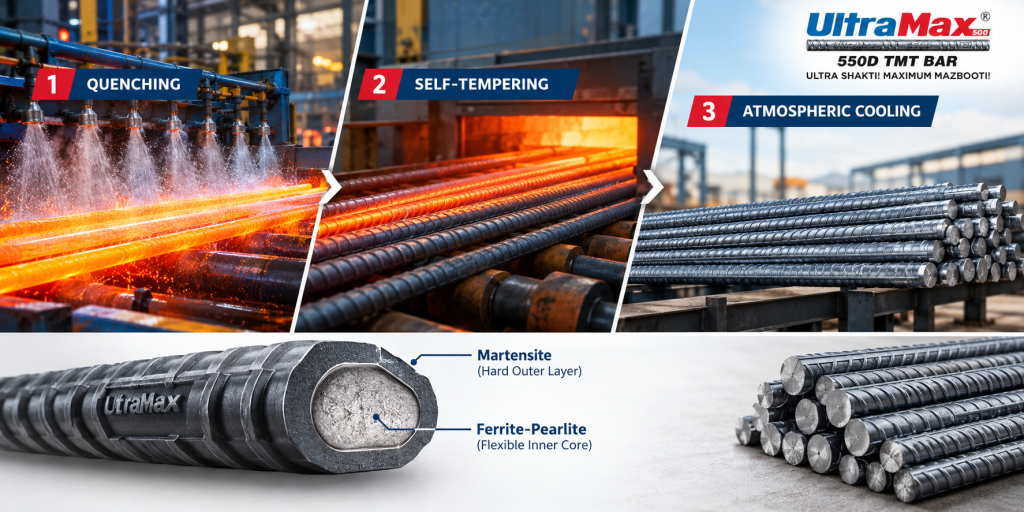
Thermo mechanically treated bars are steel reinforcement that gets stronger when treated through intense heating plus sudden cooling steps. TMT steel bars differ from ordinary steel because they go through several controlled stages – first cooled fast with spray water, then warmed slowly by their own heat, finally cooled down in air – that change how they perform under pressure.
A strong outside shell made of Martensite wraps around a bendable inside center built from Ferrite-Pearlite because of precise engineering methods. Though complex, the structure forms one solid shape where softness lives beneath hardness. The inside stays stretchy while the outer part resists damage thanks to careful material control. The shape holds together through a layered design that balances strength against flexibility. Each section plays its role since toughness needs support from give within.
Before TMT bars, builders relied on mild steel and cold-twisted (CTD or TOR) bars. Those bars had lower ductility, bonded less reliably with concrete and corroded faster, which is why TMT bars have replaced them in most modern RCC structures.
TMT Bar Grades Explained: Fe 415, Fe 500, Fe 550D and CRS
A TMT grade tells you the minimum yield strength of the bar in megapascals (MPa). In a name like Fe 500D, “Fe” stands for iron, the number is the yield strength, and the letter D marks higher ductility. All the TMT bar grades below are covered by IS 1786.
- Fe 415: Starting off, Fe 415 (415 MPa) gives decent strength while still stretching quite a bit under stress. Usually seen in homes or light architectural details where heavy weight isn’t an issue.
- Fe 500: Builders lean on Fe 500 (500 MPa) because its mix of firmness and flexibility made it stick around. Tall homes, small offices – it holds them up without fuss. Strength when needed, give where required, that became its quiet reputation.
- Fe 550D: Heavy-duty steel bars marked Fe 550D (550 MPa) stand strong when buildings face stress. Crafted with care, their mix stays light on carbon yet holds power where needed. Known for bending far without breaking, that D means deep flexibility meets unyielding resistance. During quakes, they stretch rather than snap, holding firm under crushing force.
- Corrosion-resistant (CRS) TMT bars: Hidden inside tough steel bars, tiny bits of chromium and copper wake up when wet air hits. These elements team up to block rust before it spreads deep. A tight skin builds over time, keeping acids and dampness out. Strength stays locked in because the center never weakens. This armor grows naturally – no extra steps needed.
Key Benefits of High Quality TMT Bars
Out front, newer builds demand sharper tech, so the best TMT bar makers across India keep moving fast. When you pick high-end steel from a trusted, certified Indian TMT bar producer, strength follows through every beam. What stands up longest often starts with what’s inside.
-
- Earthquake resistance: When the ground shakes, high-ductility steel doesn’t just hold on – it gives a little, stretching well beyond ordinary limits. Under IS 1786, Fe 550D bars must elongate at least 14.5% (Fe 500D: 16%) before breaking. Instead of breaking fast and hard, they sway with the jolt. Shock after shock, they flex rather than fail.
- Fire resistance: When heat rises, this rebar holds firm – its backbone stays strong past 400°C. Safety gets a quiet boost in homes and tall buildings alike because the material refuses to weaken where others collapse. Strength lingers under extreme warmth thanks to smart engineering behind the scenes.
- Strong grip on concrete: Starting strong, today’s production methods shape each bar with precision ribs – two clean ridges running nonstop along its face. These twin grooves lock firmly into wet concrete, creating a hold that stays tight. From beginning to end, consistency defines the profile, boosting how well it grips. Instead of slipping, the bond holds fast under stress.
- Easy welding: Smooth welding comes easy because the low carbon levels prevent brittleness, keeping joints strong even under field conditions. Strength stays consistent when connections are made right where they’re needed.
| Property | TMT Steel Bars | Older CTD / TOR Bars |
|---|---|---|
| Making process | Quenched and self-tempered in one controlled sequence | Cold twisted after rolling |
| Ductility | High, with a soft core | Lower |
| Welding | Good, due to low carbon content | Loses strength where heated |
| Corrosion resistance | Better, especially CRS types | More prone to rust |
TMT Uses in Construction: Where TMT Bars Are Used
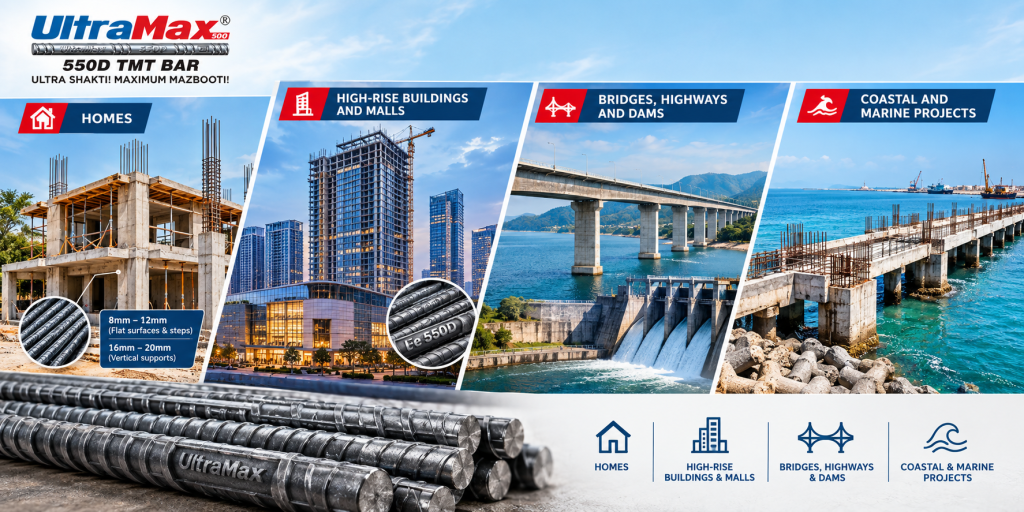
TMT bars for construction go wherever concrete needs tensile reinforcement. The main TMT uses are:
How Are TMT Bars Tested?
Quality is confirmed in a lab, not by looks. Reputed manufacturers test every batch as per IS 1786:
- Tensile test: measures yield strength and ultimate strength.
- Elongation test: checks how far the bar stretches before breaking.
- Bend and re-bend tests: confirm the bar does not crack when bent.
- Chemical composition test: confirms low carbon, sulphur and phosphorus levels.
Always ask for the batch test certificate and look for the BIS mark.
Selecting the Best TMT Bar for Your Project
One wrong move in picking a manufacturer can undo everything. When it comes to strength you can trust, UltraMax TMT Bar stands apart across India. Made by Adukia Industries and treated with the real Thermex process from Germany, each TMT bar undergoes tough checks at every stage. Solid structures start with materials that never cut corners. Performance isn’t claimed here – it’s built in.
Before you buy, check the grade, the IS 1786 compliance, the test certificate and the rib markings on the bar. Your structural engineer’s design should always decide the final grade.