

The German-designed Thermex quenching and self-tempering process behind India’s durable construction steel.
Thermex Technology at a Glance
- Thermex is a licensed quenching and self-tempering (QST) process, not a steel brand or an alloy.
- Water quenching hardens the outer layer of the bar, while the core stays soft and ductile.
- Thermex-treated TMT bars combine high strength, ductility, weldability and earthquake resistance without costly alloys.
- UltraMax Fe 550D bars are made using Thermex technology under official licensing.
What Is Thermex Technology? Thermex Meaning in TMT Bars
Thermex technology is a German-designed quenching and self-tempering process for making TMT bars. Hot-rolled bars are cooled rapidly with water right after rolling, which hardens the outer layer while the core stays soft. The Thermex meaning, in short, is a licensed heat-treatment process, not a steel brand or an alloy. People often search for it as Thermex steel, but the name describes how the bar is cooled, not what it is made of.
From Germany comes this method, designed by Hennigsdorfer Stahl Engineering (HSE) GmbH under official licensing. Not reliant on expensive alloys, it reshapes how TMT bars are made. The core lies in a special QST technique, quenching followed by self-tempering, that belongs solely to this system. Rolling mills gain the ability to create strong ribbed bars through this efficient sequence. Instead of extra materials, performance comes from controlled heat treatment during production. As one of the premier TMT bars suppliers in India, UltraMax uses this German-designed Thermex technology to deliver the best TMT bar in India for construction projects.
Key Features of German-Designed Thermex Technology
- Developed by HSE Germany and refined through years of testing in real conditions, with each step building on earlier findings.
- Backed by worldwide patents and accepted everywhere because it works straight away without fuss.
- Available only to rolling mills, through licenses granted by H&K India. Permission must come first, and the license acts as the gate.
- Relies on critical proprietary equipment specifically designed for individual mill parameters.
This special cooling method from Hennigsdorfer Stahl Engineering is used in UltraMax TMT rods.
The Thermex Process Step by Step: How Thermex Quenching Technology Works
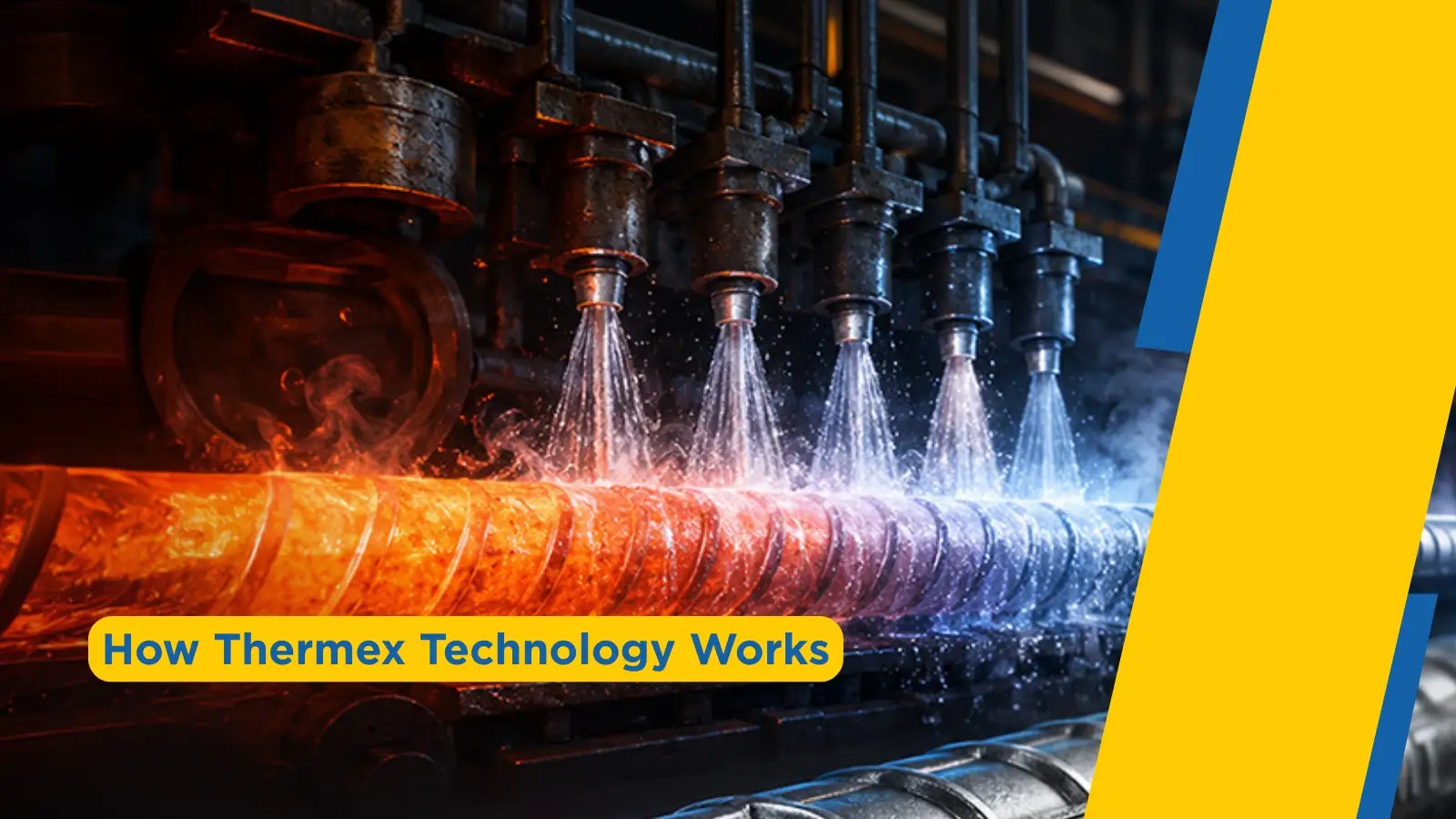
The Thermex process has five stages, all running in one continuous line right after the last rolling stand.
- Hot Roll Bar Discharge: The hot-rolled bar leaves the mill and slides straight into the Thermex water-spray setup. Cooling begins the moment the bar makes contact with the water. No extra steps show up here, and everything runs in one continuous motion.
- Rapid External Cooling: Intense water cooling pulls heat fast from the bar’s skin. Because of that rush, the outer shell locks into tough martensite. The inside stays soft and workable, so the core keeps its bending strength while the rim turns rigid.
- Core Retention: Even as the surface cools, heat holds tight at the core. Cooling done this way is called quenching.
- Self-Tempering Exchange: After the water stage, the bar rests in room air, so the heat stored inside can ease out into the hard outer layer. This heat transfer is why the step is called self-tempering.
- Final Structure Forms: The outer layer becomes tempered martensite, while the center settles into a tighter mix of ferrite and pearlite. This blend holds steady across every rebar slice.
Because the bar tempers itself with its own retained heat, Thermex quenching technology needs no reheating furnace and no costly alloying additions.
Microstructure of Thermex Bars: Why UltraMax TMT Bars Stand Out in India
What stands out about Thermex bars is their consistent internal makeup. Through this process, the outer layer transforms into a tougher form.
Microstructure characteristics: At the edges, martensite is cooled just enough to stay strong without cracking. Inside, tiny grains of ferrite and pearlite make up a center that bends more than it breaks. Spread across the slice, everything lines up evenly so nothing acts out of place.
| Layer | Microstructure | What It Does |
|---|---|---|
| Outer layer | Tempered martensite | Hardness, strength and wear resistance |
| Core | Ferrite and pearlite | Ductility, bendability and energy absorption |
What sets this technology apart is that consistent internal makeup, delivering both toughness and stretch, qualities that give UltraMax an edge in earthquake-prone areas across India.
How Thermex Technology Strengthens UltraMax TMT Bars: 6 Key Benefits
These bars pack serious strength thanks to a special cooling method called Thermex. Not every supplier across India matches what this brand offers. As one of the best TMT bar companies in India, UltraMax pairs that strength with long life against rust. A mix of smart engineering and strict checks sets the bars apart, and few companies manage both power and protection like this one does.
- Stronger Materials without Expensive Metals: Thermex QST technology builds strength through controlled cooling instead of costly alloy additions, which keeps cost down. UltraMax Fe 550D TMT bars also hold their strength well under heat.
- High Flexibility and Stretch Capacity: These rods bend without breaking and take welding well, so crews can reshape them easily on site when putting a structure together.
- Enhanced Corrosion Resistance: The uniform internal structure of Thermex-treated TMT bars helps slow rust across India’s humid and rainy regions. Because they hold up so long against wear, buildings stay intact without frequent fixes or replacements.
- Earthquake Resistance: Earthquakes hit parts of India often, and Thermex bars handle shaking well thanks to a flexible core wrapped in a tough outer shell. Their design absorbs tremors without cracking apart. Grades such as Fe 550D also carry a high UTS/YS ratio, which compares a bar’s ultimate tensile strength with its yield strength. A higher ratio means the bar stretches and gives warning before it fails, which is why IS 1786 sets stricter ductility limits for D grades. See how TMT bars help earthquake-resistant buildings.
- Cost Efficiency: Fewer rods hold more when they stretch far without breaking. Because UltraMax bars resist pulling so well while staying flexible, construction needs less metal to do the same job, which cuts the steel that goes into each build.
- Easy Weldability: UltraMax TMT bars hold their ground when welded, keeping toughness and bend without failing. Building stays smoother, with fewer extra supplies or workers needed.
Thermex Bars vs Conventional Cold-Twisted Bars
Conventional bars need cold twisting or costly alloy mixes to gain strength, while these bars gain it from the process itself.
| Feature | Thermex-treated TMT bars | Cold-twisted (CTD) bars |
|---|---|---|
| How strength is achieved | Controlled water quenching and self-tempering | Cold twisting or alloy additions |
| Internal structure | Hard tempered martensite shell, ductile ferrite-pearlite core | Cold-worked structure with residual twisting stress |
| Ductility | High | Lower |
| Weldability | Good | Limited |
| Earthquake suitability | Strong, as the ductile core absorbs energy | Limited |
Where Thermex Bars Are Used in Construction
- High-rise residential and commercial buildings
- Bridges, flyovers and other infrastructure projects
- Earthquake-prone and seismic regions
- Coastal and high-humidity locations
- Homes, offices and industrial structures
UltraMax TMT Bars: Built for Strength with the Thermex Process
At the edge of innovation, Adukia Industries crafts UltraMax TMT steel bars using the German-designed Thermex quenching process. Built tough and made to bend without breaking, these rods take strength further. Over five decades of deep knowledge and constant refinement have made UltraMax a name recognized across the nation, with a reputation earned through performance.
UltraMax TMT bars are built for small and medium builders who want lasting results without overspending. These steel bars stand firm under pressure, helping companies earn trust quicker, and the brand keeps standards high through every batch. For those scouting reliable TMT suppliers across India, one name holds steady when performance counts.
When building strong structures without overspending in India, consider Thermex-treated TMT bars. They handle stress well because of how they are cooled rapidly during manufacturing. They also resist rust better than many alternatives, so weather damage slows down. Builders trust them for projects where safety cannot be put at risk. Though price varies across regions, long-term value shows up over time. Since earthquakes shake some areas here, sturdiness becomes key, and every bar carries a mark so buyers know it meets certified standards. Construction lasts longer when the steel inside concrete does its job right, so these bars fit demanding designs just fine.

