

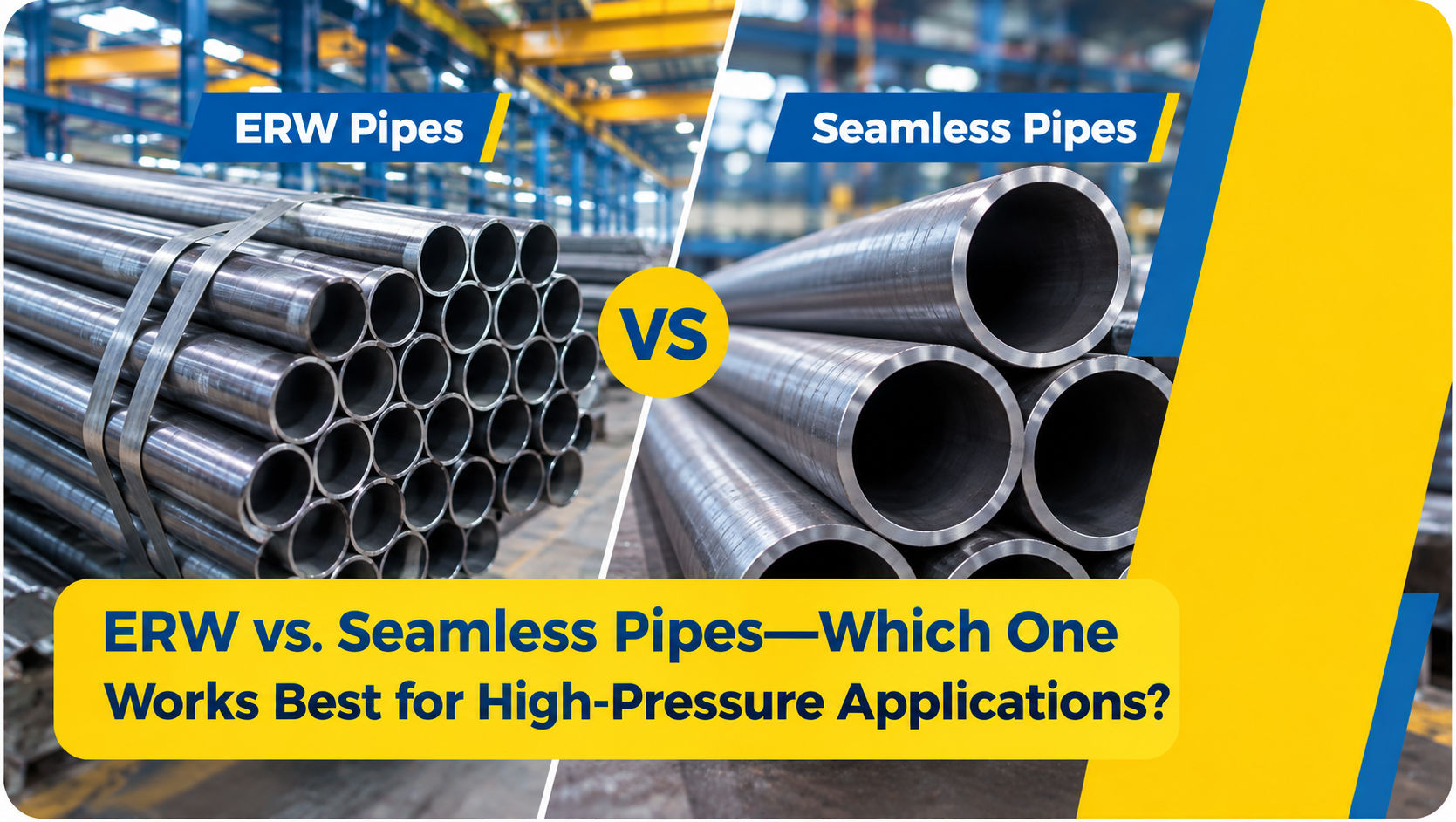
Choosing the right pipe is not just a technical decision. It is a safety decision. When pressure builds inside a pipeline, the manufacturing method behind that pipe suddenly matters a great deal. This is where the ERW vs. seamless pipe debate becomes relevant.
Both types have their place. But high-pressure applications demand a closer look before deciding which one fits the job.
What Makes ERW and Seamless Pipes Different
ERW stands for Electric Resistance Welded. These pipes are made by rolling a flat steel strip into a cylindrical shape, then welding the edges together using electric resistance. A seam runs along the length of the pipe. Modern manufacturing has improved this weld significantly, but the seam still exists.
Seamless pipes, as the name suggests, have no weld line at all. They are made by piercing a solid steel billet, then rolling and stretching it into a hollow tube. No joint. No seam. Just one continuous piece of steel.
That single difference in manufacturing shapes almost everything else about performance.
Strength Under Pressure: How They Compare
For decades, seamless pipes were considered the default choice for high-pressure use. The logic was simple. No weld meant no weak point. But that logic has evolved.
Here is what actually matters in practice:
- Modern ERW pipes, manufactured with strict quality control, achieve weld strength close to the base metal itself
- Seamless pipes still hold an edge in extreme pressure and extreme temperature environments
- Wall thickness consistency tends to be more uniform in seamless pipes
- ERW pipes offer tighter dimensional tolerances, which helps in applications needing precision
So the answer is not black and white. It depends on how extreme the pressure conditions actually are.
Where Seamless Pipes Still Lead
Seamless pipes remain the preferred choice in certain demanding environments. Oil and gas exploration at extreme depths often relies on them. High-temperature steam lines in power plants do too. Where failure carries catastrophic consequences, engineers frequently choose seamless pipe without hesitation.
The absence of a weld seam removes one variable from the failure equation entirely. That matters when margins for error are close to zero.
Where ERW Pipes Hold Their Own
ERW pipes are not the compromise choice they were once seen as. Advances in welding technology have closed much of the performance gap. They now handle a wide range of pressure applications reliably.
ERW pipes work well for:
- Structural applications requiring consistent wall thickness
- Water and gas transportation at moderate to high pressure
- Fencing, scaffolding, and construction framing
- Applications where cost efficiency matters alongside performance
UltraMax manufactures high-quality ERW pipes and tubes, longitudinally welded from strip and coil, built for reliable performance even in demanding conditions. With production capability up to 6-inch OD, these pipes serve a wide range of industrial and construction needs.
Cost Is a Real Factor, Not a Minor One
Seamless pipe manufacturing is more complex. It requires piercing solid billets and multiple rolling stages. That complexity adds cost, sometimes significantly.
ERW pipes, by comparison, are more economical to produce. For projects where budgets matter as much as performance, this difference often tips the decision. Not every high-pressure application needs the absolute highest safety margin that seamless pipe offers. Many fall well within what a quality ERW pipe can safely handle.
Making the Right Choice for Your Application
A few questions help clarify which pipe fits a specific project.
- What is the actual operating pressure, not just the theoretical maximum?
- Will the pipe face extreme temperature swings during operation?
- Is corrosion resistance or additional coating required?
- Does the budget allow for seamless pipe, or does ERW meet the requirement more efficiently?
Answering these honestly avoids over-engineering a solution or, worse, under-specifying one.
Why the Manufacturer Matters as Much as the Pipe Type
Choosing between ERW and seamless pipe means little if the manufacturing quality is poor. A reputable ERW pipe manufacturer in India will maintain strict control over strip quality, welding parameters, and testing protocols. Similarly, a reliable seamless pipe manufacturer in India will control billet quality and rolling precision closely.
Buyers should always ask for:
- Test certificates confirming pressure ratings
- Consistent wall thickness data across the batch
- Compliance with relevant IS or API standards
- Clear documentation on grade and specification
Skipping this step, regardless of pipe type chosen, is where real risk creeps in.
Final Word
There is no single winner in the ERW vs. seamless pipe comparison. The right choice depends entirely on pressure requirements, budget, and application specifics. What matters most, regardless of type, is sourcing from a manufacturer that takes quality seriously at every stage of production.
Frequently Asked Questions
1. What is the main difference between ERW and seamless pipes?
ERW pipes are made by welding rolled steel strip along a seam, while seamless pipes are formed from a solid billet with no weld line at all.
2. Which pipe type is better for high-pressure applications?
Seamless pipes generally handle extreme pressure and temperature better, but modern ERW pipes perform reliably across many moderate to high-pressure uses too.
3. Are ERW pipes cheaper than seamless pipes?
Yes, ERW pipes are typically more economical due to a simpler manufacturing process, making them a practical choice where budgets are tighter.
4. Can ERW pipes be used for gas and water transportation?
Yes, ERW pipes are widely used for water and gas transportation, especially at moderate to high pressure, when manufactured to proper quality standards.
5. How do I choose a reliable ERW pipe manufacturer in India?
Look for manufacturers offering test certificates, consistent wall thickness, compliance with IS standards, and transparency about welding and material quality.

