

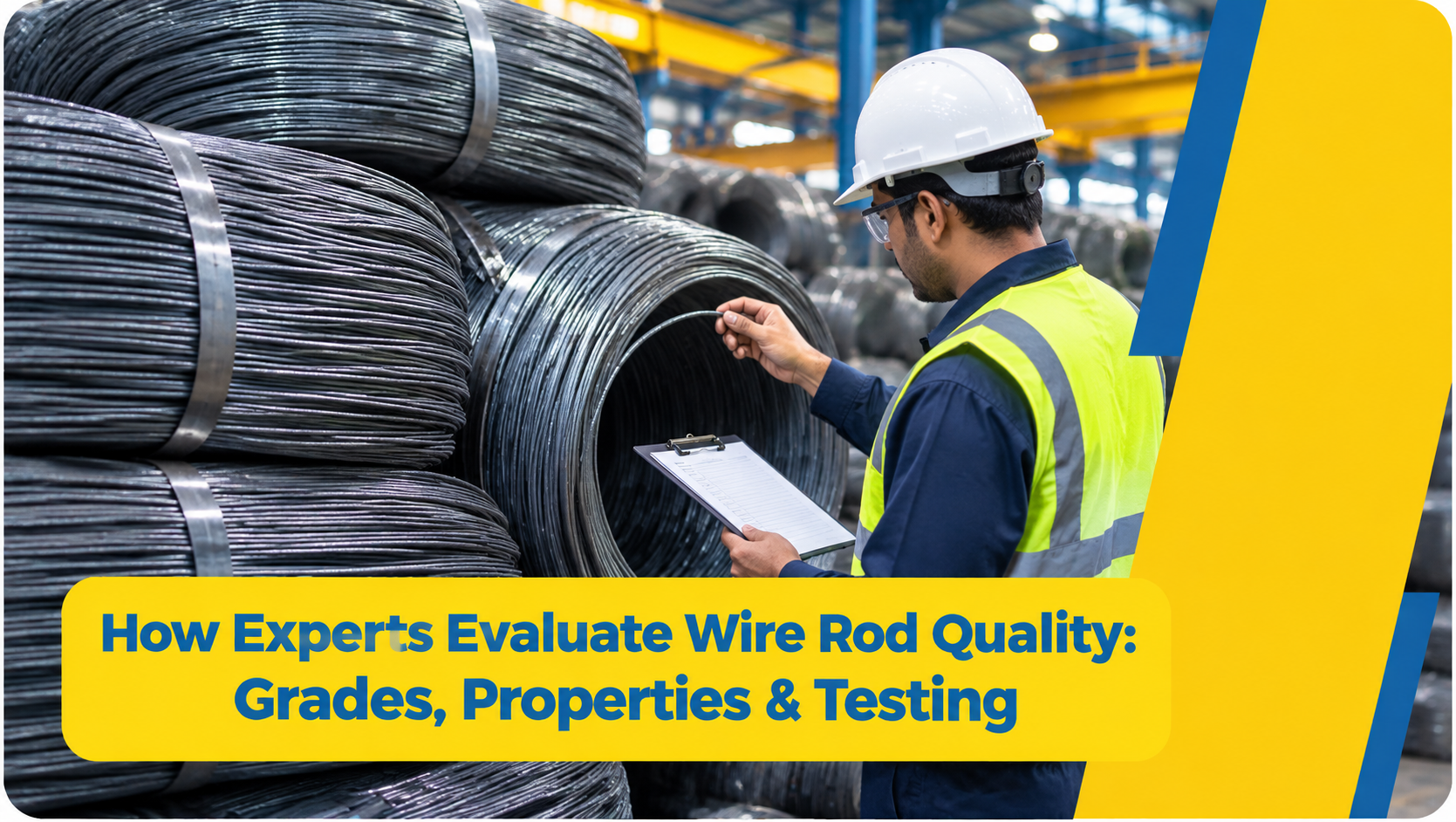
Wire rod looks simple. It is just a coiled round bar, after all. But behind that plain appearance sits a product that demands precision at every stage. Getting wire rod quality wrong has consequences far beyond the mill. It affects everything the rod eventually becomes, from binding wire to automotive components.
So how do experts actually judge whether a wire rod is good enough? It comes down to grades, mechanical properties, and testing. Nothing is left to guesswork.
Understanding Wire Rod Grades
Wire rod is not a single product. It comes in multiple grades, each suited to different downstream uses. Low-carbon grades are common. High-carbon and alloy grades exist too, depending on the application.
Grade selection depends on a few core factors:
- The carbon content required for strength or flexibility
- Whether the end use needs high tensile strength or easy drawability
- Surface finish requirements for further processing
- Chemical composition limits for sulphur, phosphorus, and manganese
UltraMax, for instance, manufactures wire rods with a diameter of 5.5mm, produced from raw materials made in-house. That in-house control matters. It means the chemistry going into the rod is monitored from the very first stage, not adjusted later to compensate for gaps.
The Properties That Actually Matter
Grade alone does not tell the full story. Wire rod quality also depends on specific mechanical and physical properties. Here is what experts look at closely.
Tensile strength comes first. It determines how much load the wire can bear before breaking. Too low, and the product fails under stress. Too high without enough ductility, and it becomes brittle.
Ductility matters just as much. A wire rod needs to be drawn into thinner wire without cracking. Poor ductility shows up immediately during drawing, often as breaks or surface defects.
Surface quality is another factor. Scale, seams, or pits on the rod surface cause problems later. They damage drawing dies. They also weaken the final wire product.
Uniform diameter matters too. Inconsistent sizing along the coil creates tension variation during drawing. This leads to uneven wire and wasted material.
Chemical composition ties everything together. Carbon, manganese, sulphur, and phosphorus levels must stay within tight limits. Even small deviations change how the rod behaves under stress.
How Testing Confirms All of This
Claims on paper mean little without testing. This is where wire rod quality gets verified in practice.
A few standard checks are used across the industry:
- Tensile testing to measure yield strength, ultimate strength, and elongation.
- Chemical composition analysis using spectrometers to confirm exact elemental content.
- Surface inspection to catch scale, cracks, or seams before further processing.
- Dimensional checks to confirm diameter consistency along the full coil length.
- Cold heading or drawing trials, especially for wire meant for fasteners or fine wire.
Each test plays a specific role. Skip even one, and defects can slip through unnoticed until they cause failure downstream.
Wire Rod Uses Across Industries
Wire rod uses stretch across a surprisingly wide range of industries. That is part of what makes quality control so critical. A defect that seems minor in one application can be dangerous in another.
Common wire rod applications include:
- Binding wire for construction sites
- Nails, screws, and fasteners
- Springs and mechanical components
- Wire mesh and fencing
- Automotive parts requiring precise drawability
- Electrodes and welding consumables
Because these applications vary so much, manufacturers cannot take a one-size-fits-all approach. A rod meant for binding wire has different demands than one destined for cold heading.
Why Sourcing From the Right Manufacturer Matters
Not all wire rod manufacturers in India maintain the same standards. Some cut corners on raw material quality. Others skip in-house testing altogether, relying only on buyer complaints to catch problems.
A dependable manufacturer will typically:
- Control raw material chemistry from the start, not just at the final stage
- Run tensile and chemical tests as a routine part of production, not an afterthought
- Maintain consistent diameter tolerances across every coil produced
- Offer test certificates readily, without buyers needing to ask twice
This is exactly where an established name makes a real difference. UltraMax leverages its expertise in heat treatment and hot rolling to produce wire rods with the precise chemistry and mechanical properties that downstream industries actually need.
What Buyers Should Check Before Purchasing
For buyers and wire drawing units, a few checks go a long way. Ask for the mill test certificate first. Verify chemical composition against the stated grade. Inspect a sample coil for surface defects before committing to a bulk order.
These steps take little time. They save considerable costs later, especially when a defective rod causes downtime on drawing lines.
Final Word
Wire rod may look like a basic industrial product, but quality here is anything but simple. Grade, properties, and testing all work together to determine real-world performance. Choosing a manufacturer that takes each of these seriously, like UltraMax, is not optional. It is essential for downstream reliability.

