

Binding wire looks like a finished product long before it actually is one. What starts as a thick coil of wire rod goes through several mechanical stages before it’s thin, flexible, and ready to tie rebar on a construction site.
Starting point: the wire rod itself
Wire rod arrives at the drawing plant as coiled round bar, typically 5.5mm to 6.5mm in diameter, produced through hot rolling. At this stage it’s far too rigid and thick for binding wire use. Its chemical composition, carbon content especially, has already been fixed at the rolling stage, and that composition determines how well the rod will behave once drawing begins.
Low-carbon wire rod is the standard choice for binding wire, since binding wire needs flexibility more than tensile strength. A rod with the wrong carbon balance will crack or work-harden too quickly during drawing, and that failure shows up as broken wire on the line, not as a defect anyone can fix afterward.
Step one: descaling
Hot-rolled wire rod carries a layer of scale, an oxide coating formed during the rolling process. This scale has to come off before drawing starts, since it damages the drawing dies and creates surface defects on the finished wire.
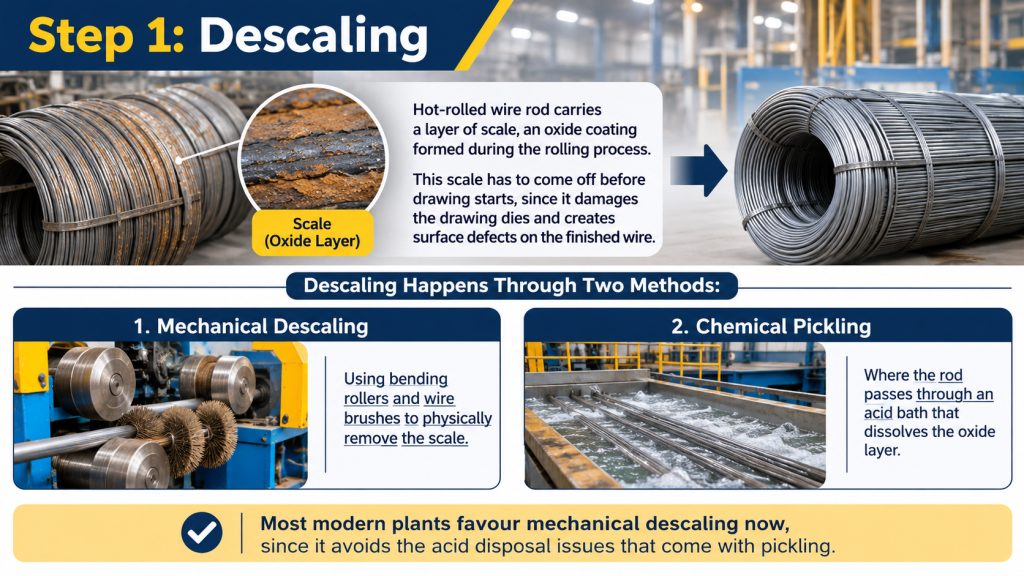
Descaling happens through one of two methods:
- Mechanical descaling, using bending rollers and wire brushes to physically remove the scale
- Chemical pickling, where the rod passes through an acid bath that dissolves the oxide layer
Most modern plants favour mechanical descaling now, since it avoids the acid disposal issues that come with pickling.
Step two: drawing the wire down
This is where the actual size reduction happens. The descaled rod passes through a series of dies, each one slightly smaller than the last, pulling the wire down in diameter with every pass.
A single pass rarely gets from 5.5mm rod to the 0.9mm or so used in binding wire. It takes multiple stages, often six to ten dies in sequence, each reducing the diameter by a controlled percentage. Push the reduction too far in one pass, and the wire snaps under the tension. Too little, and the process takes longer than it needs to.
Lubrication matters here as much as the dies themselves. Without it, friction generates heat that alters the wire’s properties mid-draw, and the dies wear out faster than they should.
Step three: heat treatment between passes
Drawing work-hardens the wire. Each pass through a die increases tensile strength but reduces ductility, and after enough passes the wire becomes too brittle to draw further without breaking.
Annealing solves this. The wire gets heated to a specific temperature, then cooled in a controlled way, which softens it and restores enough ductility for more passes. Depending on the target diameter and the carbon content of the starting rod, this might happen once or several times through the full drawing sequence.
Step four: final sizing and coiling
Once the wire reaches its target diameter, usually between 0.71mm and 1.25mm for standard binding wire for construction use, it goes through a final die pass for precision sizing. Diameter consistency matters here. Wire that varies even slightly in thickness along its length behaves unpredictably when a mason ties it around rebar intersections.
The finished wire is then coiled into standard weights, typically bundles of 25kg or 50kg, ready for dispatch to construction sites and hardware distributors.
Why this process determines real-world performance
A binding wire that snaps mid-tie isn’t a minor inconvenience on a busy site. It slows down the rebar-tying process and, in some cases, means redoing a joint that should have held on the first attempt. That failure traces back through the entire chain, past the final coiling, past the annealing, back to how the drawing sequence was controlled and what wire rod uses the plant started from.
This is exactly where sourcing matters. UltraMax manufactures its own wire rod in-house before it ever reaches the drawing stage, using raw materials produced within its integrated facility rather than sourced from third parties. That control over the starting chemistry carries through the entire drawing sequence, since a plant that doesn’t control its rod quality is drawing wire from a starting point it can’t fully account for.
What to check when sourcing binding wire
For contractors and hardware buyers, a few checks help separate reliable binding wire for construction from wire that fails under tension.
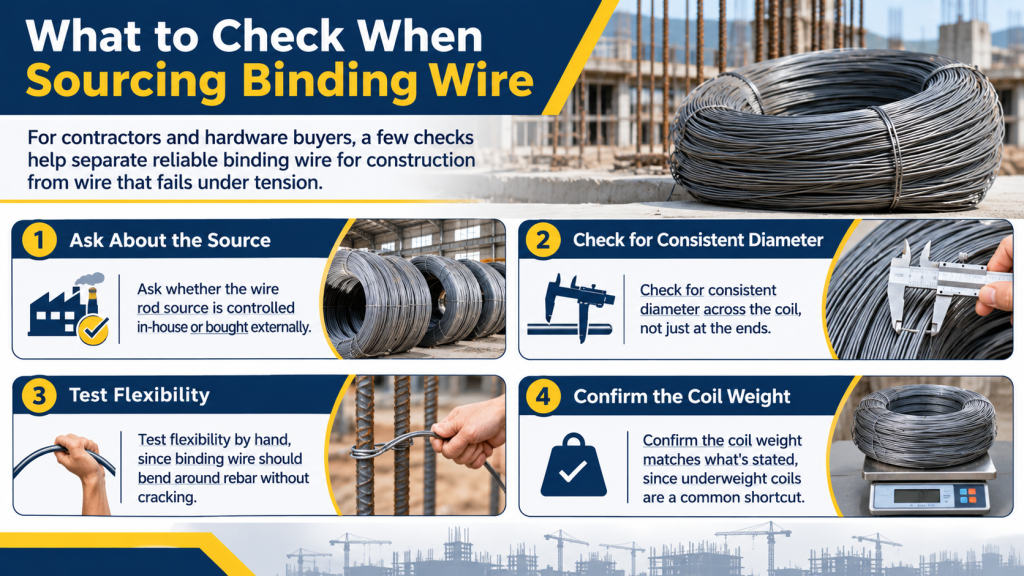
- Ask whether the wire rod source is controlled in-house or bought externally
- Check for consistent diameter across the coil, not just at the ends
- Test flexibility by hand, since binding wire should bend around rebar without cracking
- Confirm the coil weight matches what’s stated, since underweight coils are a common shortcut
