

Premium quality TMT bars ensure the structural safety of high-rise buildings by combining high tensile strength, ductility, fire stability, corrosion resistance, and strong bonding with concrete in a single reinforcement bar.
As cities grow taller, the safety and stability of high-rise buildings have become more critical than ever. The foundation and internal framework of these skyscrapers must withstand immense loads, environmental pressures, and emergencies such as fire.
Choosing the right TMT bar is crucial. Premium quality TMT Bars play a pivotal role in ensuring that these structures are secure, resilient, and durable for decades to come.
Why the Importance of TMT Bars Increases with Building Height
TMT stands for thermo-mechanically treated. During manufacturing, hot-rolled bars are quenched with water so the outer layer hardens, then the hot core self-tempers and the bar cools in air. The result is a hard outer layer with a softer, ductile core. In a tall building, columns, shear walls, and slabs carry loads that grow with every floor, so the significance of TMT bars lies in handling the tension, bending, and shear that concrete alone cannot resist.
How Premium Grade TMT Bars Strengthen High-Rise Structures
Premium TMT bars offer multiple advantages that collectively enhance a building’s resistance to physical, environmental, and thermal stresses. Here are the main ways each premium TMT bar ensures safety.
High-Strength TMT Bars for Tensile Strength and Load-Bearing Capacity
High-strength TMT bars are designed to withstand heavy loads and stresses without bending or breaking. By absorbing tensile forces, they complement concrete’s compressive strength to create a robust framework. Using the best TMT bars for construction ensures that engineers can design taller structures without compromising on stability, even under extreme loads. For example, Fe 550D bars are specified for a minimum yield strength of 550 MPa under IS 1786, which can help designers optimise steel quantity in heavily loaded members.
Resistance to Fire and High Temperatures
High-rise buildings face unique risks during fire emergencies. Fire and heat-resistant steel for tall buildings maintains structural integrity at elevated temperatures, protecting the building’s core framework and preventing sudden collapse. This buys occupants and firefighters critical time during evacuation.
Durable Steel Bars for Long-Term Durability and Corrosion Resistance
Premium TMT bars are durable steel bars, engineered for the long-term durability of reinforcement in high-rise buildings, resisting corrosion, rust, and fatigue. This durability not only extends the building’s lifespan but also reduces maintenance costs throughout its life cycle.
Superior Bonding with Concrete
The effectiveness of reinforced concrete depends on the bond between steel and concrete. Premium TMT bars offer superior bonding with concrete in construction, thanks to their ribbed surface and uniform structure. This ensures that loads are evenly distributed, prevents slippage, and improves seismic performance. In tall buildings, this bond is crucial for maintaining stability under dynamic conditions such as wind or minor earthquakes.
High Ductile TMT Bars: Flexibility and Ductility
High-quality TMT bars combine strength with ductility, and high ductile TMT bars bend without breaking under heavy stress. This property is essential for high-rise buildings, which are prone to vibrations and movements caused by wind or seismic activity. Flexible steel reinforcement absorbs shocks and prevents structural cracks, contributing to the overall safety of the building. D-grade bars such as Fe 550D are specified for a minimum elongation of 14.5% under IS 1786, which lets the bar deform and absorb energy before it fails.
Compliance with Quality Standards for TMT Bars
Premium TMT bars are manufactured under strict quality control and conform to global engineering standards. In India, the key reference is IS 1786, the BIS specification for high-strength deformed steel bars, which sets requirements for yield strength, tensile strength, elongation, bend and rebend performance, chemical composition, and weight per metre. Selecting a premium quality bar for high-rise safety guarantees that the reinforcement meets design specifications, mechanical strength requirements, and safety norms. Certified materials reduce the risk of structural failure and ensure reliability throughout the building’s lifespan. You can review UltraMax’s certifications for the standards its bars are tested against.
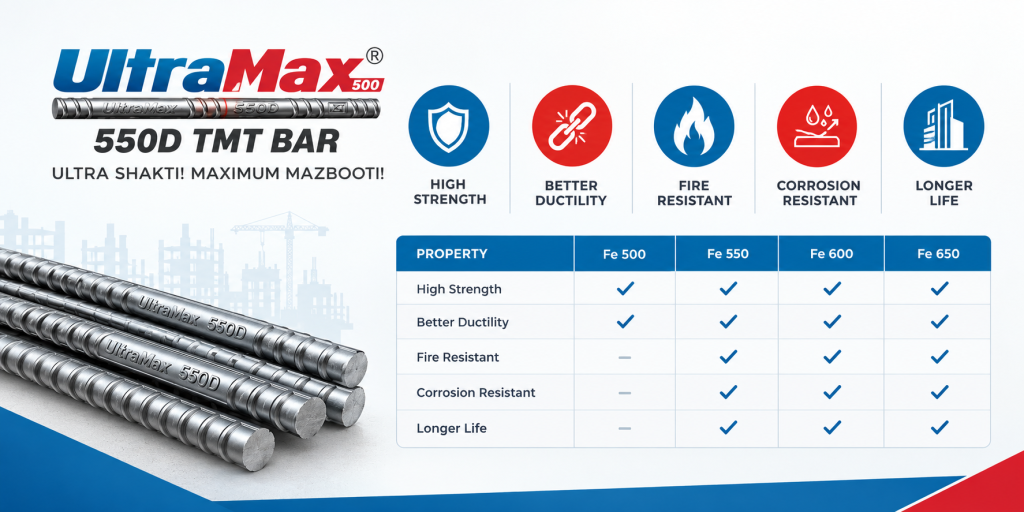
Quick Reference: TMT Bar Properties That Matter in High-Rise Safety
How to Choose the Right TMT Bar for a High-Rise Project
The best TMT bars for a high-rise project are the ones that match the design grade and arrive with proof of quality. Top-quality TMT bars share these traits:
- Clear grade marking: Ductility-critical members usually call for D-grades such as Fe 550D, as specified by the structural engineer.
- Batch-wise test certificates: Best-quality TMT bars come with mill test certificates showing yield strength, tensile strength, elongation, and chemistry for each batch.
- Uniform ribs and dimensions: Look for an even rib pattern and a clean surface with no cracks, laps, or flaking rust.
- Consistent weight per metre: Bars should fall within the tolerance allowed by IS 1786.
- Proper storage on site: Keep bars dry, covered, and off the ground so they do not rust before use.
Conclusion: Why Premium TMT Bars Matter for High-Rise Safety
The structural safety of high-rise buildings relies on more than just design—it depends on the quality of materials used. By providing strength, fire resistance, durability, superior bonding, and flexibility, premium TMT bars ensure that skyscrapers remain secure and resilient for decades, safeguarding both lives and investments. The importance of TMT bars in tall construction is therefore a safety question first, which is why specifying premium quality TMT bars with verified test certificates is always the safer choice.