

A contractor in Pune once told me his site rejected an entire truckload of TMT bars over a single failed bend test. The delivery looked fine. The invoice matched. But one sample cracked where it should have curved, and that was enough to send the whole batch back.
That’s what testing is actually for. Not paperwork. Not a formality between mill and buyer. It’s the only real way to know whether a bar will hold up long after it disappears into a column.
Tensile strength comes first, but it’s not the whole picture
Every quality check starts here. A sample bar gets pulled until it breaks, and the machine records two numbers along the way: yield strength and ultimate tensile strength.
Fe 500 needs to hit 500 MPa at minimum. Fe 550 and Fe 550D climb higher. A bar that falls short doesn’t get a pass on a technicality. It fails, and that’s the end of the conversation.
But here’s the problem with stopping at tensile strength alone: a bar can pass this test and still be dangerously brittle.
Where elongation and bend tests come in
This is where ductility gets measured. Elongation testing stretches a sample until it snaps, then records how much it stretched as a percentage of its original length. IS 1786 sets a minimum for each grade, and Fe 550D carries the highest requirement of all, since it’s built for seismic zones where flexibility can matter more than raw strength.
The bend test works differently but chases the same goal. A bar gets wrapped around a mandrel to check for surface cracking. The rebend test pushes further still, bending, straightening, then bending again at a new point.
Think about what actually happens on a construction site. Rebar gets bent into stirrups, curved around beams, shaped at column joints, over and over. A bar that cracks in a lab bend test will crack on-site too. Usually at the worst possible time.
The chemistry underneath it all
None of this happens by accident. What determines whether a bar bends cleanly or snaps comes down to chemical composition, checked through spectrometer analysis for carbon, sulphur, phosphorus, and manganese content.
Sulphur and phosphorus are the ones to watch. Push either above the IS 1786 limit, and the steel turns brittle, no matter how good the tensile numbers look. A mill that skips this test, or quietly rounds the numbers, is handing over a risk that won’t surface until the building is already standing.
Two checks that get overlooked too often
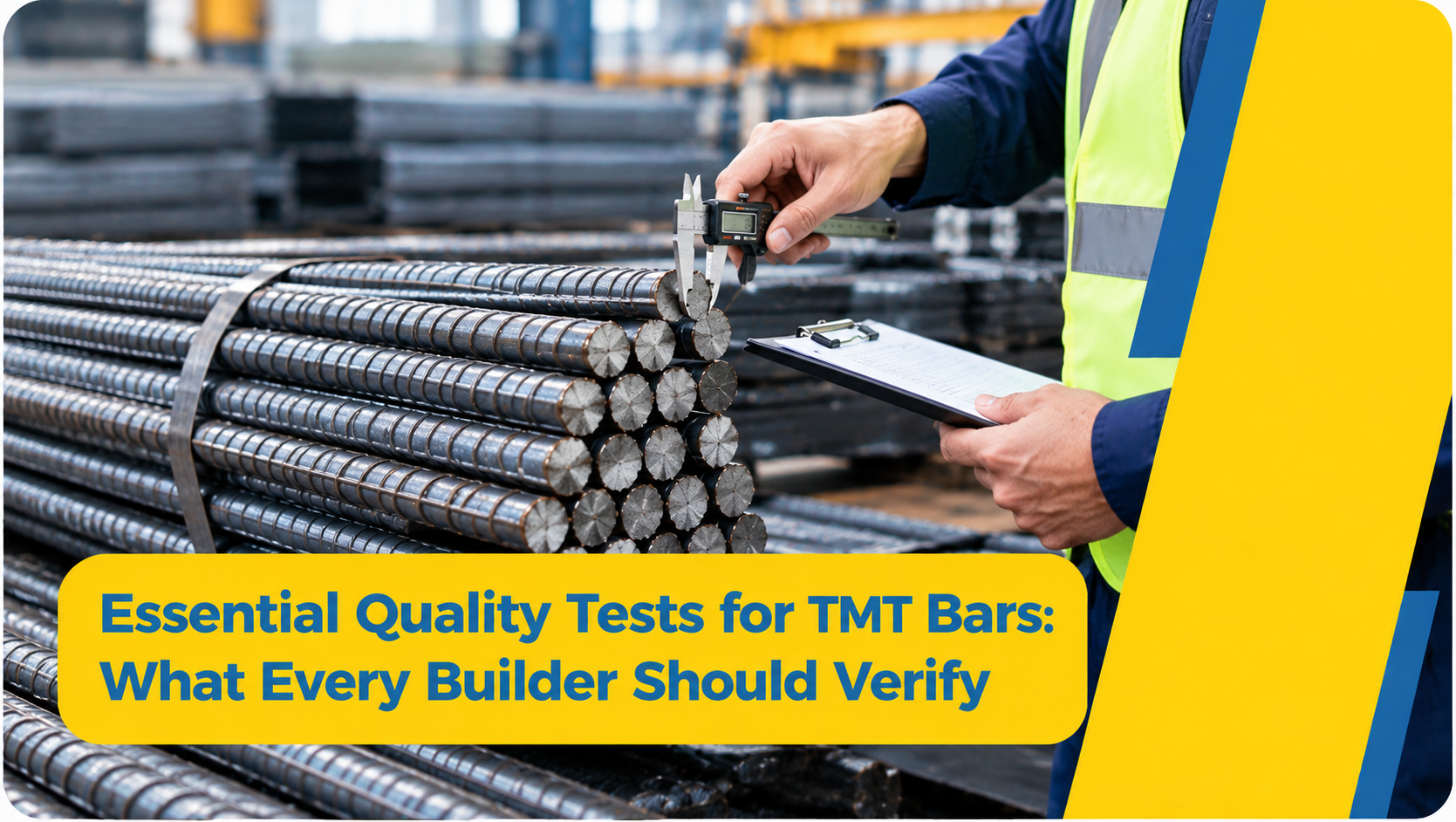
Dimensional accuracy rarely gets the attention it deserves. Diameter, rib pattern, weight per metre, all of it needs to match spec. A bar running slightly light for its stated diameter usually points to shortcuts somewhere else in production, not just a rounding error.
Corrosion resistance gets skipped even more often. Salt spray testing exposes a sample to a controlled corrosive environment and tracks how fast rust forms on the surface. Bars with a properly hardened outer layer resist this well. Bars where quenching went wrong don’t, and that gap shows up fastest in coastal construction, where corrosion problems surface within a year or two rather than a decade.
What separates an average bar from the best quality TMT bar
Here’s the thing about these six tests: they only mean something together. A best quality TMT bar clears tensile, elongation, bend, chemical, and corrosion checks as a set, not as a menu where a mill picks the convenient ones and skips the rest.
UltraMax runs its bars through this complete sequence, manufactured using German Thermex technology developed with Hennigsdorfer Stahl Engineering GmbH. The process is built to balance strength and ductility together, rather than pushing one number up while letting another quietly slide.
Before accepting any delivery
A brand name on the bar means less than a proper certificate in hand. Ask for these before signing off on a batch:
- A mill test certificate covering tensile strength, yield strength, and elongation
- Chemical composition data that matches the declared grade
- Actual bend and rebend results, not a general compliance statement
- Documentation tied to that specific batch, since certificates from a different run don’t count
- BIS certification confirming the bar meets IS 1786
Skip this step to save a few minutes, and quality of TMT bar problems tend to surface months or years later, usually at a point where there’s no fixing them.
